SK Hynix Beat Samsung at Its Own Game. Here’s the Real Reason Why.
As a Korean watching this unfold — I’ve been tracking both stocks closely myself, since I hold positions in both. And the gap between them has been impossible to ignore.
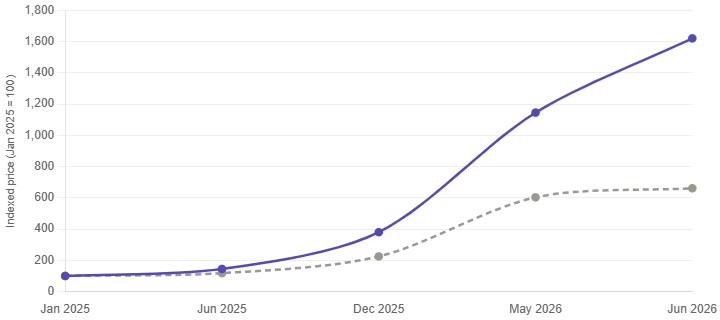
SK Hynix started 2025 around ₩170,000 and finished the year up 280%, closing at ₩651,000. Samsung Electronics started at ₩53,000 and gained 125%, reaching ₩119,900 over the same period. International Trade Administration
And right now, as of today, SK Hynix sits at ₩2,755,000. Samsung Electronics is at ₩350,500. The gap hasn’t closed. It’s widened even further.
Same industry. Same memory boom. Wildly different results. So what’s actually going on?
It All Comes Down to One Letter: H
HBM. High Bandwidth Memory. The chip that powers every major AI server on the planet right now.
As of Q2 2025, SK Hynix controlled 62% of the global HBM market. Micron took second place at 21%. Samsung was pushed down to just 17%. Jjan
That gap didn’t happen by accident.
Nvidia has prioritized SK Hynix’s HBM across its major GPU lines — H100, H200, and Blackwell — and even in the upcoming HBM4 generation, roughly 70% of Nvidia’s order volume is reportedly going to SK Hynix. Jjan
When the world’s most important AI chipmaker keeps choosing you first, the market notices. And it pays accordingly.
Samsung Isn’t Out of the Race — But It’s Playing Catch-Up

Here’s where it gets interesting, though.
Samsung still carries a “recovery hope” narrative in the market. Rising general DRAM and NAND prices support its earnings improvement, and the expectation of expanded HBM4 supply combined with deeper entry into the AI chip ecosystem opens the door to a stock re-rating. But Samsung still carries the image of a late mover in the HBM market compared to SK Hynix. For its stock to move meaningfully past the 300,000 won mark, Samsung needs more than a cyclical recovery — it needs to prove HBM competitiveness with real numbers. Statista
SK Hynix, on the other hand, is a stock the market has already awarded an HBM premium to. The bigger AI accelerator demand grows, the more bargaining power flows to whoever controls HBM supply. Statista
That’s the entire story in two sentences.
The Numbers Behind the Hype
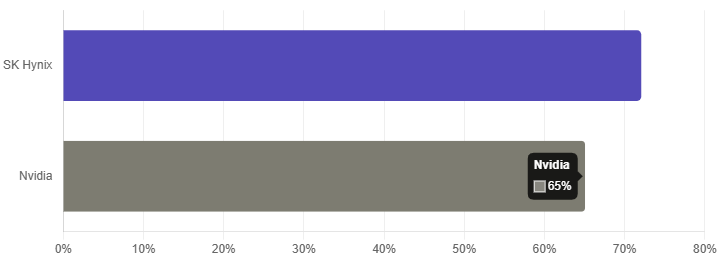
In Q1 2026, SK Hynix posted revenue of ₩52.58 trillion, up 198% year-over-year, with operating profit surging 405% to ₩37.61 trillion — a 72% operating margin that surpassed even Nvidia’s 65%. A memory chip company out-margining Nvidia. Let that sink in. Hupu
SK Hynix shares briefly touched an all-time high of ₩1,949,000 on May 11, pushing the company’s market cap past $900 billion, up roughly 197% year-to-date. Hupu
There’s even a nickname for it now in Korea — 백만닉스 (baek-man-nik-seu), “Million Hynix,” referring to the stock crossing the ₩1 million mark. Given that it’s already well past ₩2.7 million now, that nickname might already be outdated.
Then Came May 27 — A New Chapter for the Korean Stock Market
On May 27, 2026, Korea’s stock market made history. For the first time ever, single-stock leveraged and inverse products tracking individual companies were listed on the KOSPI — and the two underlying assets chosen were Samsung Electronics and SK Hynix.
A total of 18 products launched that day — 16 ETFs and 2 ETNs — with a combined initial listing size of roughly ₩4.32 trillion, an unprecedented scale for a single day of ETF/ETN listings in Korean market history. Single-stock leveraged products like those tracking Tesla or Nvidia have long been popular in the U.S. market, and now Korea finally has its own version, with the government framing it as a way to pull investment demand back from overseas markets into domestic exchanges.
The effect was immediate. Both stocks hit new all-time highs at the open. SK Hynix jumped 10.48% to ₩2,267,000, triggering a volatility interruption (VI) mechanism right at the opening bell. Samsung Securities’ “KODEX SK Hynix Single Stock Leverage” ranked 4th in trading volume that day, while Mirae Asset’s “TIGER SK Hynix Single Stock Leverage” came in 9th.
But the launch also raised some eyebrows. The KOSPI index jumped over 2% that day — yet fewer than 80 stocks actually rose, while more than 820 declined. On paper, it looked like a strong rally. In reality, trading was heavily concentrated in these two stocks and their leveraged products, highlighting just how dependent the entire index has become on a handful of semiconductor giants.
That’s the real story here — SK Hynix and Samsung aren’t just two companies anymore. They’ve become the engine driving the entire Korean stock market.
But Samsung Has a Counter-Play
This isn’t a closed book, though.
For Nvidia’s next-generation Vera Rubin platform — its first major lineup to fully adopt HBM4 — TrendForce reports that Nvidia is qualifying all three major suppliers (Samsung, SK Hynix, and Micron) to reduce single-vendor dependency risk. TrendForce’s analysis suggests Samsung may actually achieve certification first, leveraging its product stability, with SK Hynix and Micron following. The Historian Traveller
SemiAnalysis goes further, projecting a supply split scenario where SK Hynix takes around 70% and Samsung the remaining 30% of HBM4 orders. The Historian Traveller
That 30% might sound small next to SK Hynix’s dominance — but for a company that held just 17% of the HBM market a year ago, it would represent real progress.
My Take
As someone holding both stocks in my own portfolio, here’s how I see it.
SK Hynix earned its premium. It bet on HBM early, built the relationship with Nvidia that matters most, and the numbers — that 72% operating margin — prove the strategy worked. This isn’t hype. It’s execution.
Samsung isn’t broken. It’s playing catch-up in HBM specifically, while still benefiting from the broader memory supercycle in general DRAM and NAND. Whether Samsung can convert “first certification” into real order share by late 2026 is the variable every investor in Korean tech stocks should be watching closely. The Historian Traveller
And now, with leveraged ETFs amplifying every move these two stocks make, the volatility — in both directions — is only going to get sharper.
Two Korean giants, one AI memory boom, two very different stories. I’m watching both closely — and so is the rest of the market.
— Your Korean insider 🇰🇷