Can SK Hynix Hit $300? Here’s What Would Have to Go Right
SK Hynix ADR: How High Does the Market Actually Expect It to Go?
As a Korean watching this unfold — just one day after SK Hynix debuted on Nasdaq, the market is already locked in a fierce debate over exactly how much higher this thing can go.
Analyst Price Targets Are Split in an Almost Shocking Way
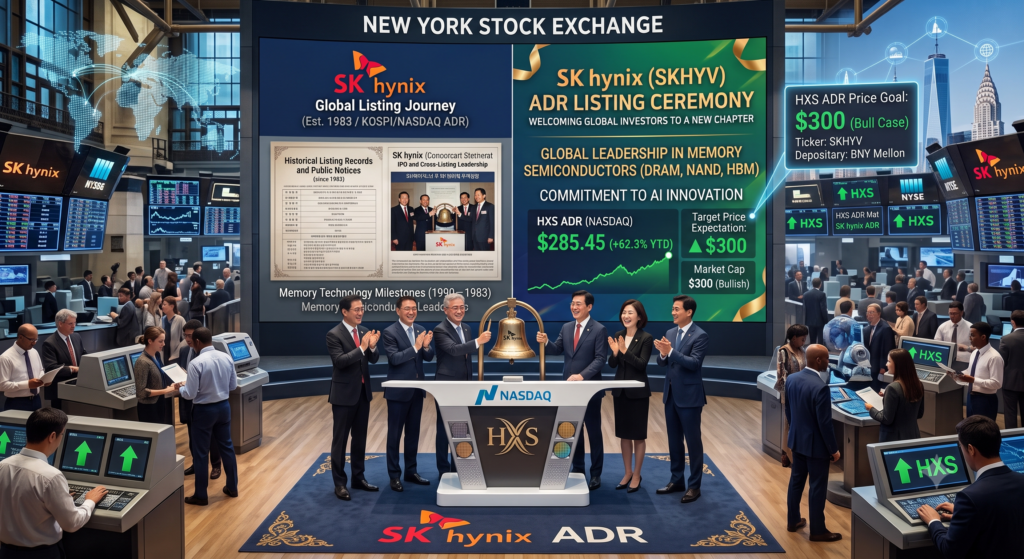
As of the July 10 listing day, Korean brokerages have issued price targets that couldn’t be further apart.
BNK Investment & Securities set its target at ₩1.85 million (roughly $1,232), while Hanwha Investment & Securities came in at ₩4.3 million (roughly $2,864). That’s a gap of ₩2.45 million (about $1,632) between the two firms. BNK issued what amounts to a de facto sell-adjacent “Hold” rating, while KB Securities and Hanwha both maintained aggressive Buy ratings with targets in the ₩4 million range.
Looking at the broader analyst consensus, 35 of 37 covering analysts rate the stock a Buy, one recommends Sell, and one says Hold. The average 12-month price target sits at ₩3,207,962. Converted to ADR terms using the 10:1 ratio, that works out to roughly $213.
The Bear Case: “This Might Already Be the Cycle Peak”
The skeptical camp has a coherent argument, too.
BNK’s analyst Lee Min-hee diagnosed the situation this way: “While AI server DRAM and enterprise SSDs are still facing supply shortages, the competitive infrastructure spending race among hyperscalers placing these orders is no longer valid.” In plain terms — the fear is that Big Tech’s arms-race-style capex spending on AI infrastructure could be losing steam.
Add to that rising supply from Chinese competitors, concerns about potential HBM oversupply, and lingering questions about how sustainable semiconductor capex spending really is.
The Bull Case: “Price Increases Are Running Ahead of Expectations”
Hanwha’s analyst Park Jun-young makes the opposite argument. He’s raising SK Hynix’s projected second-half DRAM price increase from 15% quarter-over-quarter to roughly 20%, explaining that “strategic price negotiations will result in a higher rate of price increase than the market currently expects.”
HSBC projected that the ADR could trade at roughly a 20% premium over the Korean-listed shares following the Nasdaq debut — which translates to an ADR price target of around $290. The most bullish Korean analysts have targets that imply an ADR-equivalent price of roughly $341.
Analysts Even Disagree on Whether the Listing Itself Matters
Here’s what’s genuinely fascinating: it’s not just the price target that’s contested — analysts can’t even agree on whether the Nasdaq listing itself is a meaningful event.
BNK called the ADR issuance “neutral,” stating that “it provides convenience for overseas trading, but the valuation of the underlying shares is not expected to change.” KB Securities took the opposite view, arguing that “the US ADR listing will expand accessibility for global investors, which is expected to affect the valuation of both the US-listed and Korean-listed shares.”
The Actual Opening Price Came in Lower Than Expected
Here’s an interesting wrinkle. Ahead of the listing, HSBC and other institutions projected the ADR would open with a premium already baked in, around the $200 mark. Instead, it opened at $158.
That gap has become part of the bull case, not a red flag. $158 represents a starting point below what analysts had assumed was “fair value” pre-listing — which means the percentage climb required to hit a $300 target is actually larger and more achievable in relative terms than it would have been from a $200 starting point, even though the absolute dollar target hasn’t changed.
What Would It Take to Reach $300?
There’s growing chatter in the market about whether SKHY could reach $300 by the end of 2027 — roughly doubling from its $158 opening price.
Getting there would require three separate drivers to line up:
1. Earnings — the most concrete lever
Q2 2026 earnings, due July 29, are expected to show revenue roughly doubling from Q1’s already extraordinary level. HBM4 commands a 40-50% price premium over HBM3E, and as the product mix shifts further toward HBM4 through the rest of 2026 and into 2027, that margin improvement flows directly into earnings per share.
2. Valuation re-rating — closing the Korea discount
SK Hynix currently trades at a forward P/E of roughly 6-7x, compared to about 13x for its closest US peer, Micron. The entire logic of the Nasdaq listing was to help close that gap.
3. Nasdaq 100 inclusion — December is the key date
Part of the reason SK Hynix chose Nasdaq over the NYSE was specifically to position itself for inclusion in the Nasdaq 100 Index. The market widely expects that inclusion to happen during the routine index rebalancing this December — at which point passive funds tracking the QQQ ETF would be required to buy shares automatically.
What the TSMC Precedent Suggests
The reason TSMC keeps coming up in every one of these discussions is instructive. TSMC’s ADR has consistently outperformed the consensus expectations that existed at comparable stages of its US accessibility journey — largely because the valuation discount created by geographic access restrictions turned out to be larger than analysts had modeled before that restriction was lifted.
Bulls are betting SK Hynix follows a similar pattern.
A Structural Quirk in the Arbitrage Mechanism
Here’s a technical detail worth understanding. Arbitrage between the ADR and the Korean shares isn’t a fully free two-way channel.
According to regulatory filings, ADR holders can cancel their ADRs to convert into Korean shares, but the reverse — buying Korean shares and converting them into ADRs — may require approval from Korean regulators and isn’t always straightforward. This means that when the ADR trades at a premium, arbitrageurs can’t easily close that gap by buying the cheaper Korean shares and converting them. That asymmetry is part of why premiums like TSMC’s have historically been able to persist rather than get arbitraged away quickly.
The Risks That Could Derail the $300 Case
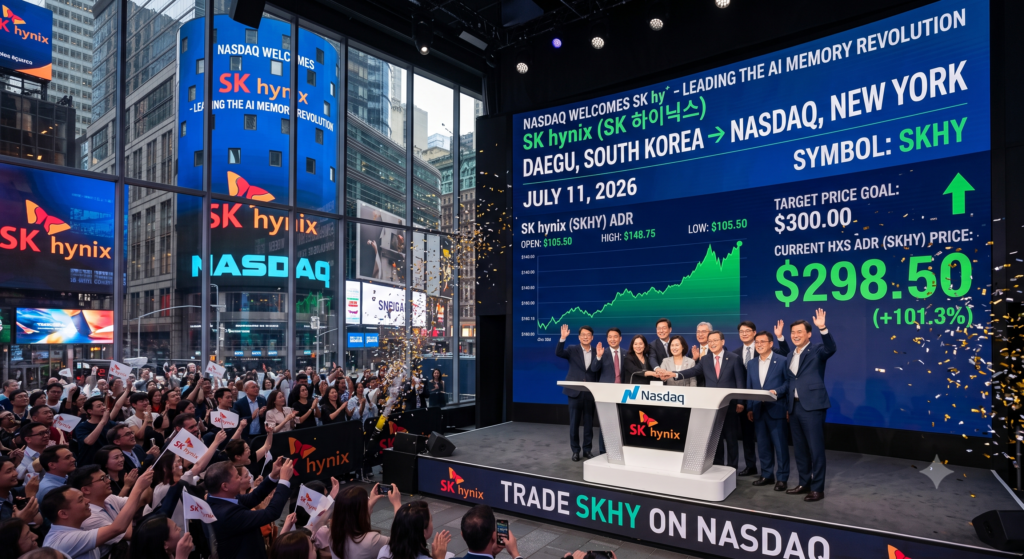
The single biggest competitive risk is Samsung Electronics closing the HBM technology gap faster than current market share data suggests. There’s also currency risk — a weaker Korean won against the dollar would eat into dollar-denominated returns for ADR holders.
And if the July 29 earnings report disappoints against the market’s extraordinarily high expectations, that wouldn’t just delay the $300 scenario — it could push SKHY back down toward, or even below, its Korean-share-equivalent value.
My Take
As someone holding SK Hynix in my own portfolio, the sheer spread in these price targets — from ₩1.85 million to ₩4.3 million, or roughly $123 to $286 in ADR terms — tells you just how divided professional opinion really is on this stock right now.
But a few themes show up consistently across nearly every analyst report: the sustainability of AI memory demand, the shift toward HBM4 in the product mix, and whether Nasdaq 100 inclusion actually materializes in December. How those three questions resolve over the next few months will likely determine whether SK Hynix follows TSMC’s re-rating story, or gets weighed down by cycle-peak fears instead.
Two dates worth marking on the calendar: July 29 for Q2 earnings, and December for the Nasdaq 100 rebalancing decision.
— Your Korean insider 🇰🇷