Jensen Huang’s Four Gifts to Korea — And the Homework He Left Behind
He landed at Gimpo on June 5. He left this morning, June 9.
Four days. And Korea hasn’t quite caught its breath yet.
Jensen Huang’s five-day visit wrapped up earlier today, and as a Korean who’s been watching every move of this trip, I want to do something the news coverage mostly hasn’t: slow down, look at what he actually brought, and then ask the harder question — what does Korea have to do now to make it count?
Because the gifts were real. But so is the homework.
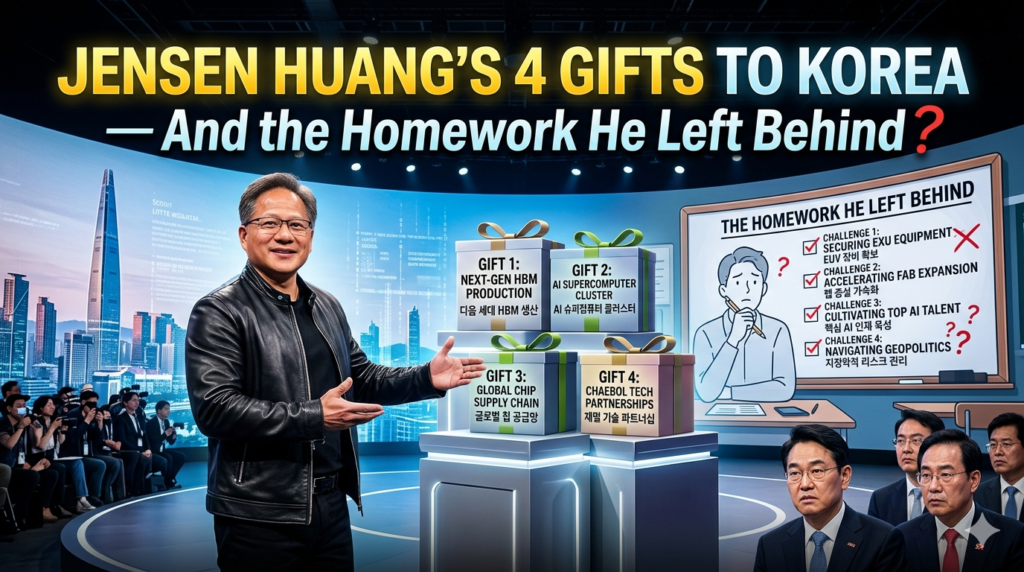
The Four Gifts
Gift 1: Vera Rubin — Korea Is Inside the Chip
The first gift wasn’t a handshake or a speech. It was a certification.
On June 5, the day he landed in Seoul, Huang publicly confirmed that Samsung and SK Hynix had both passed qualification to supply HBM4 memory for Vera Rubin — Nvidia’s next-generation AI accelerator, now in full production. Industry estimates put SK Hynix at roughly 60 to 70 percent of total HBM4 volume, with Samsung taking most of the rest.
Think about what that means. Every Vera Rubin system that ships anywhere in the world — to data centers in the US, Europe, Japan, the Middle East — will have Korean memory running inside it. Korea isn’t supplying a component. Korea is inside the brain of global AI infrastructure.
That’s not a small thing.
Gift 2: An AI Cloud the Size of a Gigawatt
The second gift came out of Huang’s meetings with SK Group Chairman Chey Tae-won — who he met three times in less than a week, including once at Computex in Taipei and twice here in Seoul.
The result: SK Telecom and Nvidia announced a partnership to build a gigawatt-class AI cloud in Korea based on Nvidia’s DSX architecture, targeting commercial launch in 2027. Separately, Naver confirmed it will deploy Nvidia technology to expand its GAK Sejong data center from 55 megawatts to gigawatt-scale.
A gigawatt of AI compute. In Korea. That’s not a pilot program. That’s infrastructure.
Gift 3: Physical AI — Korea as the Testing Ground
The third gift was perhaps the most forward-looking.
At the Korea AI Ecosystem Reception held at the Shilla Hotel on June 8 — Huang’s final major event before leaving — attendees included not just Samsung, SK, LG, and Hyundai, but robotics and physical AI companies like Doosan Robotics, RealWorld, Arobot, and Robotis.
Huang’s message was clear: from Nvidia’s perspective, Korea is its top physical AI partner outside the United States.
Physical AI — robots, autonomous machines, systems that operate in the real world — needs three things: hardware, software, and real-world operational data. Korea has all three. Decades of heavy industry. World-class manufacturing. And now, companies willing to plug that data into Nvidia’s platforms.
Ryu Jung-hee, head of Korean robotics startup RealWorld, put it plainly after the meeting: physical AI is a complete group project. Korea, right now, has the pieces to play.
Gift 4: A Promise Worth Hundreds of Billions
The fourth gift was the one Huang saved for last.
Standing at the Shilla Hotel on Sunday evening, he said it directly: “Over the next five years, hundreds of billions of dollars in revenue will flow into South Korea.”
He’s said big things before. But he backed this one up. The partnerships announced this week — HBM4 supply, AI cloud infrastructure, physical AI collaboration, the R&D center — aren’t promises on paper. They’re contracts, roadmaps, and hiring plans.
For a country that’s spent decades building the manufacturing backbone of global tech, this was Huang’s way of saying: the payoff is starting now.
The Homework
Here’s where I want to be honest, as a Korean.
The gifts are real. But Huang himself pointed to the gaps — and they matter.
“Korea already possesses world-class semiconductor manufacturing capabilities and an advanced AI ecosystem, but AI infrastructure is still insufficient,” he said. “Just as the semiconductor industry needed fabs, AI also needs factories.” ServeTheHome
AI factories. That’s what Korea is missing. The chips are world-class. The manufacturing is world-class. But the data centers, the compute infrastructure, the AI cloud layer — that’s still being built.
The gigawatt-scale cloud partnerships with SK Telecom and Naver are a start. But Korea has a target of 200,000 high-performance GPUs by 2030, and getting there means solving real problems: energy supply, cooling infrastructure, and building fast enough to keep up with demand that isn’t waiting.
The second piece of homework is startups. Huang urged the venture capitalists present, calling them out by name, to invest in AI startups — and reportedly told Deputy Prime Minister Bae Kyung-hoon that what these companies need is money, asking for government-level funding support. Kim Sung-hoon, head of Korean AI company Upstage, summed it up simply: “If I sum up today’s meeting in one word, it was investment.” The Korea Herald
Korea has the big companies. Samsung, SK, LG, Hyundai — they’re all in. But the next wave of AI isn’t going to come from conglomerates alone. It’s going to come from startups moving fast, taking risks, and building things that don’t exist yet. That culture still needs to grow here.
The third piece is the hardest: moving from supplier to creator. Korea’s strength has always been making things better, faster, and at scale. That’s an incredible foundation. But in the AI era, the highest-value position isn’t the best manufacturer — it’s the one who defines what gets built. Korea needs to start building AI products and platforms that the rest of the world uses, not just the infrastructure that others build on.
What This Week Actually Meant
For past years, global investors viewed Korea’s tech giants through a single lens: a vital but vulnerable component pipeline. When the memory market boomed, Seoul rallied. When it cratered, the benchmark KOSPI followed. Tom’s Hardware
That paradigm is breaking.
What happened this week wasn’t just a CEO visit. It was a signal that Korea’s role in global AI is expanding — from component supplier to strategic partner across memory, cloud, robotics, and physical AI simultaneously.
The gifts were generous. The homework is real. And the next five years will determine whether Korea just received Huang’s gifts gracefully — or actually did something with them.
Standing here, watching all of this unfold in real time, I think we’re ready.
But we’ve got work to do.
— Your Korean insider 🇰🇷