Why the World Is Obsessed With HBM4 — And Why It’s Made in Korea
There’s a Korean export that’s quietly become one of the most important products on the planet, and most people outside the tech world have never heard of it.
It’s not K-pop. Not Korean skincare. Not even Samsung phones.
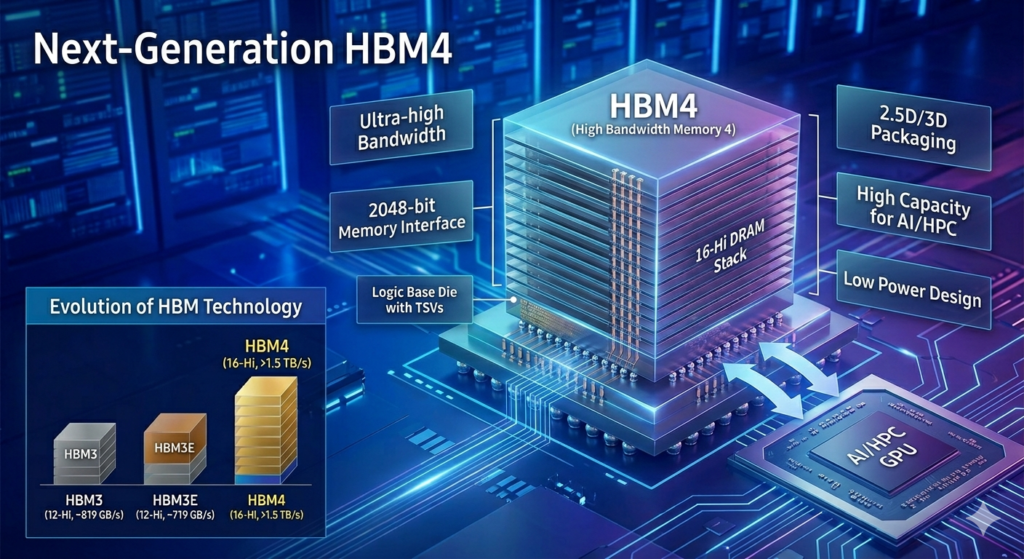
It’s a little stack of memory chips called HBM4.
That’s the thing Jensen Huang keeps flying to Korea for. It’s why he sat down for pork belly with our biggest chairmen last week, and why — at a trade show in Taipei — he scribbled “Please Make More” on a memory wafer and signed his name under it.
I’ve been following this story for months now, and I don’t think the rest of the world quite gets how big a deal it is for Korea. So let me try to explain it the way I’d explain it to a friend.
Okay, so what is HBM?
HBM stands for High Bandwidth Memory. The easiest way to think about it:
If an AI chip is a brain, HBM is its short-term memory.
A high-end AI processor — say, one of Nvidia’s GPUs — can crunch an absurd amount of math every second. But here’s the catch. None of that matters if you can’t feed it data fast enough. The chip ends up just sitting there, brilliant but basically starving, waiting around for information to arrive.
That’s the problem HBM was built to fix. Instead of laying the memory out flat next to the processor, HBM stacks the chips straight up — layer on layer, kind of like a tiny skyscraper — and parks them right next to the GPU. Shorter distance for the data to travel, way more of it moving at once.
HBM4 is the sixth generation of this. The newest and fastest version anyone’s making.
Why this is a Korean story
This is the part I get a little proud about.
The HBM market basically comes down to three companies: SK Hynix, Samsung, and Micron from the US. Two of the three are Korean.
And it isn’t a tight race, either. The estimates floating around the industry put SK Hynix at somewhere around 60 to 70 percent of the HBM4 volume for Nvidia’s new platform. Samsung picks up most of the rest — call it 25 to 30 percent. Do that math and Korean companies are making the overwhelming majority of the most important memory in the entire AI industry.
Go back to that wafer Huang signed. “Please Make More.” The CEO of the most valuable company on earth, more or less asking a Korean firm to please hurry up and produce more chips. That tells you everything about who’s holding the cards right now.
Where Vera Rubin comes in
Last week it all kind of clicked into place.
On June 1, at his keynote in Taipei, Huang said Nvidia’s next big AI platform — it’s called Vera Rubin — had gone into full production. Then on the 5th, the day he landed in Seoul, he confirmed that Samsung, SK Hynix, and Micron had all been certified to supply the HBM4 for it.
What he told reporters at the airport was blunt: all three vendors qualified, all three in production, all of them racing to support Vera Rubin.
And Vera Rubin is a monster. Nvidia’s claiming ten times the AI throughput of their last platform, with shipments starting in the third quarter of this year. Every one of those systems needs HBM4 — and a lot of it.
So basically every Vera Rubin unit that ships anywhere in the world is going to have Korean memory running inside it.
Why Huang won’t stop visiting
Now the whole week makes a different kind of sense.
The PC bang stop with Faker. Dinner with the heads of SK, LG, and Naver. Throwing a first pitch in a Doosan jersey. The new R&D center.
None of that is just Huang being friendly. He needs Korea — specifically, he needs SK Hynix and Samsung cranking out HBM4 fast enough to keep up with demand he can’t seem to satisfy. That’s why he shows up in person. When you lean on a partner this hard, you fly over, you shake the hands, you sit down for the dinner.
People have started calling this supply-chain diplomacy. Whatever you call it, Korea’s in a really strong spot.
So what does this actually mean?
Here’s my honest read, sitting where I’m sitting.
For decades Korea was the manufacturing country. Phones, ships, cars, displays. World-class at all of it, but usually somewhere in the background of someone else’s product.
HBM4 flips that. In the AI era Korea isn’t in the background — it’s right in the middle of the thing. Right now, without Korean memory, you basically cannot build the most advanced AI systems in the world at any real scale. That’s not me being patriotic. That’s just where the supply chain happens to sit in 2026.
So next time you’re using some AI tool — a chatbot, an image generator, whatever’s humming away in a data center on the other side of the world — there’s a genuinely good chance a piece of it was made here.
A little stack of chips from Korea, helping run artificial intelligence basically everywhere.
For a country this size, that’s not bad at all.
— Your Korean insider 🇰🇷